Pints, Pinot and Post-Show Talk: Why Hackney's Theatre Foyers Refuse to Call Last Orders
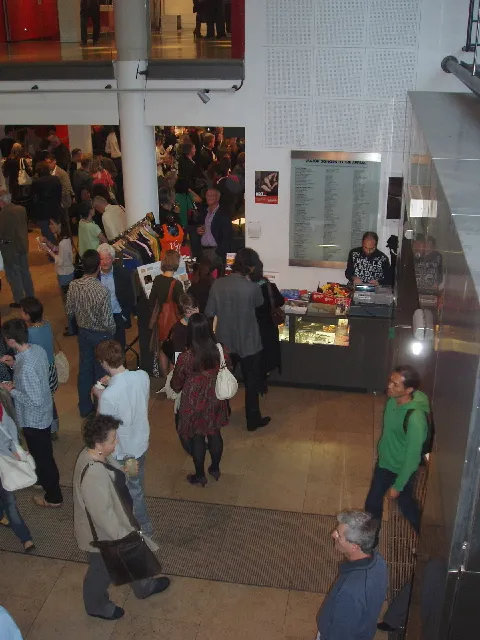
Photo: David Hawgood, CC BY-SA 2.0, via Wikimedia Commons
At 8.47pm on a Thursday, the Arcola's basement bar is doing a brisk trade in warm white wine and cold lager. Upstairs, a play is heading towards its crisis. Downstairs, two strangers are arguing — happily — about whether the second act was better than the first. This is the intermission economy, and in Hackney it is booming.
The curtain is only ever half the story. From the Arcola's Dalston bar to the Yard's makeshift counter in Hackney Wick, from Hackney Empire's ornate foyers to the pub-theatre snug at the Rosemary Branch, the interval drink has become a stage of its own. It is where audiences compare notes, performers decompress, programmers swap numbers and the next collaboration quietly begins. The best conversations often happen with a pint in hand — and a bell about to ring.
The bell that doesn't mean goodbye
'People think the interval is a break from the show,' says Nadia, bar manager at a Dalston theatre who has worked front-of-house for eleven years. 'It's not. It's the second performance. The audience is performing being audience. The cast is performing being normal. The bar staff are performing a kind of controlled chaos.'
On a busy night, Nadia's team can serve 180 drinks in fifteen minutes. The fridges are stacked like a Tetris board; the card machine is charged; the interval playlist is carefully chosen to keep the room warm without drowning out conversation. 'If the bar is grim, people leave at half-time and don't come back,' she says. 'If it's good, they stay for one more and book for the next show. That's the whole game.'
That game is not unique to Hackney, but it is unusually visible here. The borough's theatres are small enough that the bar is never far from the stage, and big enough that the room fills with a genuine mix: actors in fleeces, critics with notebooks, locals who have popped in on a whim, and teenagers who have just discovered that theatre can be funny, strange and cheap on a Tuesday.
From ice bucket to ideas exchange
For performers, the interval is a strange kind of limbo. You are still half in character, still sweating under the lights, but suddenly expected to make small talk about the buses. Joel, an actor who has appeared at the Yard and Hoxton Hall, says he used to hide in the dressing room. Now he makes a beeline for the bar.
'I've had more useful conversations at interval than at some networking events,' he says. 'You're not pitching. You're just queuing for a drink and someone says, I loved the bit where you did that thing, and suddenly you're talking about a project. The bar is where the guard comes down.'
That lowering of guards is the point. The interval economy is not just about selling pinot grigio at a mark-up. It is about creating a space where the audience and the artists can occupy the same room without a proscenium arch between them. At the Rosemary Branch, a pub theatre where the bar is literally the front door, that has always been the model. At the Yard, the makeshift counter and the scrap-timber aesthetic make the bar feel like part of the set. At Hackney Empire, the grand foyers do the opposite: they invite you to dress up, linger and pretend you are in the West End for an hour.
The economics of a second act
None of this happens by accident. Bar managers talk about dwell time and conversion — the art of turning a ticket-holder into a second-drink buyer and, ideally, a returning customer. In 2026, with ticket prices under pressure and funding still fragile, that matters more than ever. The bar is not an add-on to the business model; it is part of the business model.
'We plan the interval like we plan the show,' says Nadia. 'We know how long the first act is. We know when the rush will hit. We know what sells when it's raining and what sells when it's hot. We know that if we run out of ice, we might as well close.'
Pop-up counters have become part of the mix, too. Local breweries, coffee roasters and food traders rotate through foyers, turning a quick drink into a small market. It gives independent businesses a foothold and gives audiences a reason to arrive early. 'The bar is a community space that happens to sell alcohol,' says one programmer. 'The alcohol pays for the community space.'
Where the next show gets born
The best interval conversations are not always about the show. Priya, an audience member at a Hackney Empire comedy night, says she once spent twenty minutes in the bar talking to a stranger about the difficulty of finding a decent rehearsal room. 'By the end, we'd swapped numbers and I'd agreed to help produce a scratch night,' she says. 'I came for the play and stayed for the argument. That's Hackney.'
That is also the intermission economy in miniature: a space where the audience becomes a collaborator, where a chance encounter becomes a project, where the night out becomes a night in the life of the scene. The bar is the hinge between the performance and the after-party, the place where the show is digested and the next one is dreamed up.
Last orders, first drafts
The bell rings. The audience drifts back to their seats, clutching glasses and half-finished sentences. The bar staff reset the fridges. Somewhere a napkin has a phone number on it, and a director is already texting a comedian about a shared bill. The curtain rises on the second act. Downstairs, the lights stay on.
The intermission economy is not a footnote to Hackney's theatre scene. It is the interval that keeps the whole thing going — one pint, one conversation and one five-minute warning at a time.