Before the First Punchline: How Hackney's Comperes Build a Room from Scratch

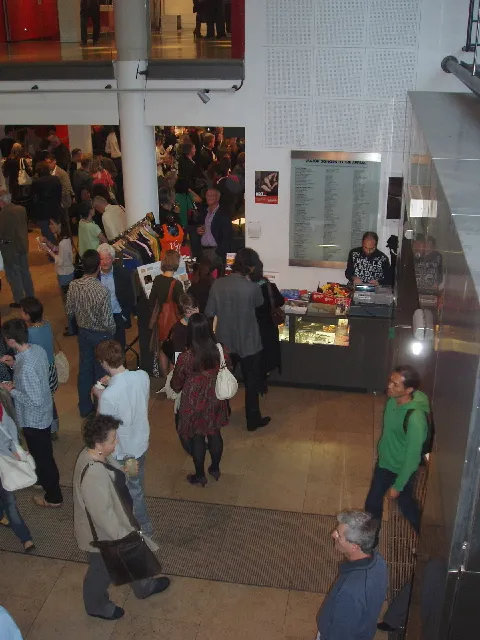
Photo: Fawzi AC from London, UK, CC BY 2.0, via Wikimedia Commons
It is 7.58pm at a comedy night in Hackney, and the room is not ready. Two people are still at the bar. Someone's coat is on someone else's chair. The sound engineer is making a noise like a dial-up modem. At the side of the stage, the compere is doing the most important work of the night: nothing, visibly, while watching everything.
The five-minute warning is not really for the audience. It is for the MC. It is the moment when the room stops being a collection of strangers and becomes a crowd — or doesn't. In Hackney's comedy scene, where nights run in pubs, clubs, back rooms and former factories, the compere is the thread that holds the evening together. They warm up the room, set the tone, handle the hecklers and, if all goes well, make the first act look like they walked into a party rather than a tribunal.
The five-minute warning
'You can feel it before you see it,' says Maya, who has compered nights at the Moth Club and the Glory. 'At five minutes to showtime, the room has a temperature. If it's too cool, you need to turn it up. If it's too hot, you need to calm it down. If it's just a bunch of people staring at their phones, you need to give them permission to be here.'
That permission is the compere's real job. A good MC does not just tell jokes; they build a container. They establish the rules — phones away, be kind, laugh when you mean it — and then they break them gently. They make the audience feel like they are in on something rather than waiting for something.
Femi, a compere who runs a monthly night in a Dalston back room, compares it to hosting a dinner party. 'You don't start with the heavy stuff,' he says. 'You start with the weather, the room, the fact that someone has brought a birthday balloon. You find the shared thing. Then you can go anywhere.'
Reading the room before you speak
The best comperes arrive early. They watch the audience come in. They notice who is drunk, who is nervous, who is on a date, who has been dragged along. They clock the front row. They make a mental map of the room's energy before they ever touch the mic.
'You are looking for allies,' says Ruth, a comedian and compere who has worked the Hackney circuit for eight years. 'Not victims. Allies. If you can find three people who are up for it, the rest of the room will follow. If you pick on someone who doesn't want to play, you lose the room. It's that simple.'
That means the old-school heckle-down is out. The comperes I speak to are more interested in the swerve than the put-down. A heckler is not an enemy to be destroyed; they are a disruption to be absorbed. 'You can say something like, I love that you're invested, and move on,' says Maya. 'You don't have to win. You have to keep the night moving.'
Hecklers, latecomers and the art of the swerve
Latecomers are the other great test. A door banging in the middle of a set can kill a laugh stone dead. The compere's job is to make the interruption part of the show without making the latecomer feel like a criminal. 'You say, Come in, come in, we've been waiting, and then you give them a job,' says Femi. 'Ask them to hold something. Ask them where they've come from. Suddenly they're in the room, not outside it.'
The same principle applies to technical failures. A dead mic, a flickering light, a barista firing up the coffee machine at the worst possible moment: the compere turns the glitch into a bit. 'The audience wants to know that someone is in charge,' says Ruth. 'If you panic, they panic. If you laugh, they laugh.'
Building a laugh without stealing one
There is a delicate etiquette to warming up a room. The compere is not there to do their best material; they are there to make the acts look good. That means keeping the energy high but not hogging it, getting the first laugh of the night without burning the room's goodwill.
'You can't do twenty minutes of your own stuff and then expect the first act to follow it,' says Maya. 'You do five, maybe seven, and you leave them wanting more. You hand over a room that is warm, not exhausted.'
The best comperes also know how to handle a tough crowd. A silent room is not necessarily a hostile room. 'Sometimes they're just listening,' says Femi. 'Sometimes they're just tired. You have to give them a chance to come to you. If you start accusing them of being boring, you've lost.'
Tips from the comperes' notebook
For anyone thinking of stepping up to the mic, the professionals offer a few hard-won rules. Arrive early. Learn the acts' names and pronounce them properly. Know where the toilets are. Have a plan for the first two minutes and the last two minutes; the middle can look after itself. Never blame the audience for a quiet night. And always, always have a water bottle.
'Don't try to be the funniest person in the room,' says Ruth. 'Try to be the most generous. The room can feel that. It changes everything.'
At 8.05pm, the compere steps up. The room settles. The first joke lands — not a huge laugh, but a real one. The night has started. The five-minute warning has done its job.