Tuned Before Curtain: The Pre-Show Playlist as Hackney Stagecraft
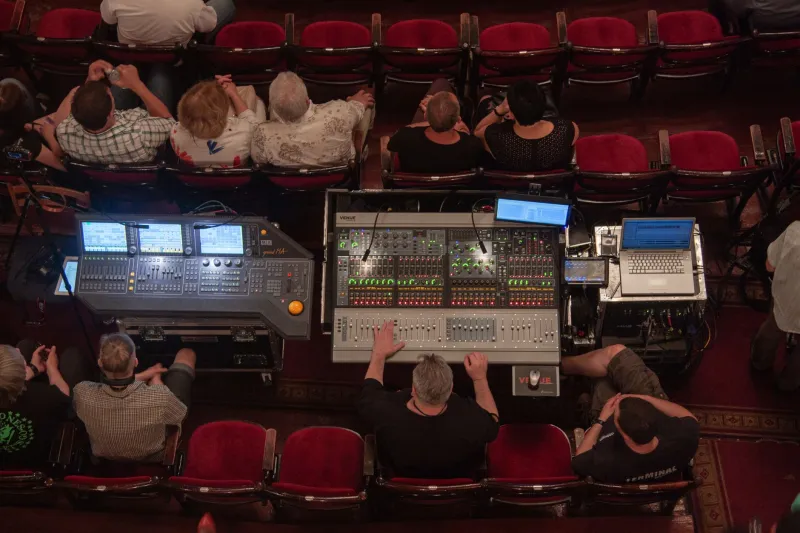
At 7.12pm on a Thursday, a 70-seat room off Mare Street is still mostly empty. The house lights are at half, the bar has run out of clean glasses once already, and the duty sound engineer is crouched behind a laptop, watching the room rather than the screen. The playlist has been running for eighteen minutes. Nothing about it looks like stagecraft. It is just a sequence of songs, mostly mid-tempo, mostly familiar, with the volume nudged just under the point where people have to raise their voices. And yet the room has already started to behave differently.
That is the odd, under-discussed job of the pre-show playlist. It is not simply background music. In Hackney’s theatre and comedy rooms — the converted pubs, the upstairs halls, the black-box spaces with flats above and bus routes outside — it is one of the first technical cues of the night. It sets a pace, gives people permission to settle, and quietly tells them what kind of evening they are about to have.
The room has a pulse before anyone arrives
A good pre-show playlist is built for the room, not for the person choosing it. That sounds obvious, but it is easy to forget when you are three songs deep into a personal favourite and the front row is shouting over a guitar solo.
In practice, venue programmers and sound engineers tend to think in phases. The first phase is arrival music: something warm, low-stakes and just audible enough to soften the awkwardness of walking into a half-empty space alone. The second phase is the settling phase, when the room fills and the bar queue shortens. The third is the turn: the last ten or fifteen minutes before curtain-up, when the music starts to lean forward. Maybe the tempo lifts. Maybe the lyrics become sharper, funnier, more confrontational. Maybe it simply gets a little louder, then drops away entirely.
“You are not just filling silence,” one Hackney programmer tells me. “You are managing attention. If the room is chatty, you do not necessarily turn it up. Sometimes you turn it down so people lean in. If the room is nervous, you give them something they recognise. If it is a comedy night, you want the room loose but not pissed. If it is theatre, you want them curious but not already watching a performance.”
That last point matters. A pre-show playlist is not the show. It should not compete with the show. It is a hand on the shoulder, not a shove.
Calm, then charge: mapping the arc
One of the more interesting shifts in recent years has been the move away from generic “chill” playlists towards something more deliberate. A room that opens with ambient electronica and ends with a blast of pop-punk is telling the audience a story: settle in, then get ready. A comedy room that runs soul and funk before a new-act night is doing something similar, but with a different promise. It says the evening will be warm, social and a little bit messy.
The arc is not always obvious to the audience, which is the point. If the playlist is doing its job, you should not notice the joins. You should just feel the room change. The chatter drops. The phones go away. The bar staff start clearing glasses more quietly. By the time the stage manager gives the five-minute call, the music has already done half the work of gathering everyone into the same moment.
There is a practical side to this too. In shared buildings, volume is not a free-for-all. Hackney venues deal with flats above, offices next door, late-night licences and sound limiters that cut in when the bass gets ambitious. The pre-show playlist has to sit inside those limits. It has to be loud enough to warm the room but not so loud that the first complaint arrives before the first act. That is why so many venues run their playlists through the same desk and the same limiter as the show. It is not just a laptop plugged into a speaker. It is part of the system.
The licence, the neighbour and the limiter
And yes, there is paperwork. Publicly playing recorded music in a venue generally means covering both the composition and the recording — in the UK, that usually means PRS for Music and PPL, often through The Music Licence. Venues that host live music and recorded music need to think about both, and smaller rooms sometimes rely on staff who are already doing three jobs. The result is a pre-show playlist that is often more carefully managed than it looks: licensed, logged and kept within the terms of the venue’s premises licence.
It is not the most romantic part of the job. But it is part of the craft. The right track at the right volume is a small act of consideration — for the audience, for the neighbours, and for the performers who need the room to be in the right condition when they walk on.
Access is not an afterthought
There is also an access dimension that often gets overlooked. For neurodivergent audience members, a sudden burst of loud music can be jarring; for others, total silence before a show can feel exposing. Some venues now build “settling” playlists for relaxed performances that avoid sudden dynamic shifts, heavy bass or lyrics that cut through the room. Others offer a quiet space away from the speakers and make sure the pre-show music is not the only thing holding the room together.
The best versions of this are not announced as a big gesture. They are just built in. A slightly gentler playlist. A volume cap. A note on the website. The kind of thing that makes a room feel less like a test and more like an invitation.
The last song is a cue, not a vibe
Back on Mare Street, the room is nearly full. The engineer checks the time, fades the current track, and lets one last song run. It is not the most obvious choice — a bit older, a bit stranger — but it does something useful. It gives the latecomers a moment to find their seats without feeling watched. It gives the front row something to talk about. And then, at the exact right moment, it stops.
The silence that follows is not empty. It is charged. The stage manager walks out, the house lights dip, and the room is ready. Nobody applauds the playlist. Nobody should. But it has already done its job: it tuned the room before anyone said a word.