The Hot Seat Isn’t a Free-for-All: Inside Hackney’s Front-Row Etiquette

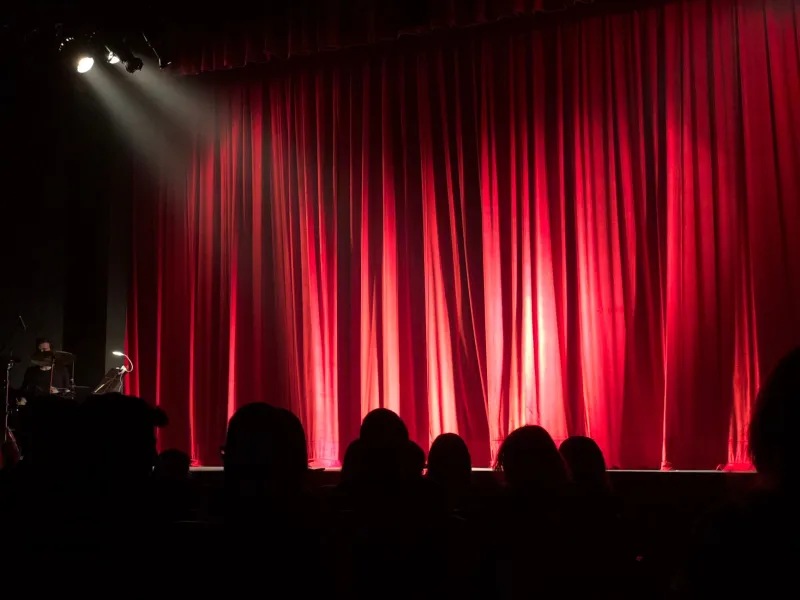
It’s a wet Tuesday in November 2026, and the basement room off Mare Street is already full. The comic onstage squints into the lights and asks the usual question — ‘Anybody here from round here?’ — and the front row answers. Not all at once. A woman in a leopard-print coat says Homerton. A man with a pint says he’s just moved to Clapton. Someone else says they’re from Leeds and gets a cheer. The exchange takes maybe forty seconds. It also sets the temperature for the next hour.
This is the front row in Hackney comedy: not a random sample, not a baying mob, and definitely not a free-for-all. It is a placement, a performance and a small social contract that gets renewed every night. The people who sit there know it. The comics know it. The staff on the door know it best of all.
The front row is a placement, not a dare
In the 80-to-150-capacity rooms that make up the solid middle of Hackney’s comedy scene — back rooms, basements, the odd former textile unit with a black curtain and a decent PA — the front row is partly self-selected and partly curated. Regulars gravitate there. So do extroverts, comedy nerds, people on dates who want to be close to the action, and a surprising number of punters who simply want to see the whites of a comic’s eyes.
But venue staff do not fill the front row last. They fill it deliberately. ‘We are not trying to create a bear pit,’ says Frankie, a front-of-house lead who has worked Hackney rooms for eight years. ‘We are trying to create a room where people can be close without feeling trapped. If a group comes in already loud, we might split them. If someone says they are nervous, we do not put them in the hot seat to teach them a lesson. That is not our job.’
The front row also has an access dimension that gets lost in all the banter chat. For some audience members, sitting close is about lip-reading or low vision. For others, it is about being near the exit. A good seating plan is not a joke delivery system; it is a small act of care. The front row is exposed, yes. But exposure should be chosen, not inflicted.
Backchat, banter and the difference between a gift and a tax
Maya, a comic who runs a monthly night in Dalston, has a useful test. ‘I do not mind a heckle if it is a gift,’ she says. ‘A heckle that is a gift adds something to the room. A heckle that is a tax takes something away. The question is: are you giving me something to work with, or are you asking the room to look at you instead?’
That distinction is not always obvious from the cheap seats. A quick correction can be funny. A question can open a comic up. A shouted punchline can land like a gift if the timing is right and the intent is generous. But repetition changes the chemistry. So does volume. So does targeting another audience member. The line is not between ‘nice’ and ‘nasty’ — it is between contribution and takeover.
In 2026, more Hackney rooms are naming that line out loud. Some comics open with a light-touch briefing: join in if you want, but let the room breathe. Some venues brief front-of-house staff to watch for the moment a bit of backchat turns into a running commentary. Nobody is asking for silence. This is a comedy scene, not a library. But there is a growing understanding that ‘banter’ is not a magic word that makes everything acceptable.
The soft power of the door
Frankie describes door work as ‘reading the room before the room knows itself’. You watch how people arrive. You notice who is three pints in at 7pm and who is nursing a lime soda. You see the group that is already performing for each other in the queue. You clock the couple who have clearly had a row and the mates who have come out to cheer someone up.
That information shapes the seating. It also shapes the mood. ‘We are not censoring anyone,’ Frankie says. ‘We are pacing the room. If someone is on one, we might put them near the back, not because we want to punish them but because we want everyone else to have a night. The front row is not a bin. It is not where we put the problem. It is where we put the people who can hold the conversation.’
Some rooms now use a host or audience-care lead to check in with the front row before the show. It sounds soft, but it is practical. A quiet word at the bar — ‘You are welcome to chat back, but if the comic moves on, let them move on’ — prevents a lot of avoidable friction later. It also gives first-timers permission to enjoy the show without feeling like they have to prove something.
When the room has to referee
The tricky nights are rarely about one big outrage. They are about accumulation. A punter keeps shouting the same line. A group treats every pause as an invitation. A comic tries to surf the chaos, then loses the thread. The audience starts to shift. You can feel it in the laughter: it gets thinner, more scattered, less generous.
That is when staff step in. Not always with a tap on the shoulder. Sometimes it is a look, a moved glass, a quiet word at the end of the row. The best intervention is boring and early. The worst is late and theatrical. ‘We are not there to humiliate anyone,’ Frankie says. ‘We are there to keep the room porous. People need to be able to leave, cool off, come back, or not come back. That is basic.’
Comics have their own tools. Some will name the behaviour lightly. Some will change gear and bring the room back to the material. Some will simply stop and wait. The audience usually knows what is happening. A room can police itself with a collective shift in energy — the turned shoulder, the lowered laugh, the person who says ‘oh, give it a rest’ under their breath. Kindness is not the same as politeness. A room can be polite and still cruel. The front row contract works best when it is explicit about that.
A contract renewed every night
The same seat can be a launchpad on a Friday and a trap on a Sunday. Early shows have a different pulse from late ones. Payday crowds are not the same as the crowd that has just come from a shift. Weather matters. So does the news. So does the Overground. A room’s mood is a living thing, and the front row is where it shows up first.
That is why the etiquette is never finished. It is not a laminated list of rules. It is a conversation — sometimes a funny one, sometimes an awkward one — about who gets to speak, who gets to be protected, and what the room is for. Hackney’s comedy audiences are not uniquely well-behaved. They are just unusually close to the action, and increasingly willing to treat that closeness as a responsibility rather than a right.
The front row is not the hot seat. It is the handshake. And in 2026, the best rooms in Hackney are learning to make that handshake a little clearer, a little kinder, and a lot more fun.